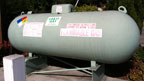
Although storage tanks for home heating oil can range in size from 50 to 20,000 gallons, there are common residential sizes in two basic types -- tanks designed to be installed aboveground are usually about 275 gallons and located in a basement, garage or shed, while underground tanks are typically 550 or 1,000 gallons.
Typical costs:
Removing the old heating oil tank can run $500-$3,000, depending on local rates and the size of the tank, its condition and how easily it can be reached. Aboveground tanks are typically less expensive to remove than underground tanks. Required soil testing to check for contamination can add $300-$500.
Installing a replacement tank (typically aboveground) can be $1,000-$2,000 or more, depending on size, location and type of tank (options such as steel, fiberglass or a combination, and single or double wall construction).
This brings total costs for removing an old tank and installing a replacement to $1,800-$5,500 or more. A Connecticut fuel and equipment dealer[1] estimates that a ballpark price to remove a 550-gallon underground tank covered only by grass with no obstructions and no contamination runs $1,100 to remove it, test the soil, fill the hole and plant grass seed, plus another $1,600 to install a new 275-gallon aboveground tank, or a total of $2,700 for removal and replacement.
If the required soil testing reveals contamination in the ground around the old tank, cleanup costs can be $2,500-$10,000 for minor contamination. The Oregon Department of Environmental Quality estimates that a typical heating oil cleanup project can run $3,500-$4,600, depending on the methods used. However, if there's extensive contamination, cleanup costs can go as high as $15,000-$100,000 and up. Many insurance companies have added "pollution exclusion" clauses to homeowner insurance policies, making homeowners responsible for all cleanup costs.
Many older tanks (typically prior to 1985) are made of bare steel, with no corrosion protection, and will rust or get pinhole leaks, especially if installed underground or outdoors without protection from the weather. These older tanks generally last 15 to 20 years. More modern tanks may be made of fiberglass or a combination of plastic and steel, with either a single or double wall construction, and are predicted to last up to 30 years. OilheatAmerica.com[2] provides an overview.
Before installation, a heating oil tank should be carefully inspected and all water and ice (from condensation during shipping) removed from the interior. A Massachusetts heating oil tank specialist[3] provides a diagram of a typical aboveground oil tank installation, and a tank manufacturer provides detailed installation guidelines for an aboveground tank.
Permits are usually required when removing either an aboveground or underground tank. The tank must be emptied out and disposed of properly. The Massachutsetts Department of Environmental Protection[4] recommends taking notes and photos to document the work, even if everything seems to be going well.
Most underground residential heating oil tanks are small enough that they are exempt from federal regulations, but are governed by state or local laws. All states require a permit to install a new heating fuel oil tank, and permits are often issued by the local fire department. Check with the state's ecology/environmental agency and the local fire department.
Additional costs:
There may be additional costs for repairing the landscaping after a heating oil tank has been removed, particularly if it was underground.
It costs about $500 to test an existing underground tank and pipes to see if there are any leaks. Some experts recommend removing an old tank without this testing, because an aging tank has the potential to leak eventually. The Wisconsin Department of Commerce describes that state's rules regarding tank testing[5] .
Discounts:
It might be possible to negotiate a group discount if several homes in a neighborhood need to replace old heating oil tanks.
If contamination cleanup is required after underground tank removal but not covered under a homeowners' insurance policy, check with the state's ecology/environmental agency to see if there are grants available to help with at least some of these costs.
Shopping for a heating oil tank:
Manufacturers of heating oil tanks include ConTec and Grandby Industries, and the Oilheat Manufacturers Association provides lists of manufacturers and associations[6] related to home heating oil and furnaces.
Most tank removal contractors are local businesses. Get referrals for a tank removal contractor from the local heating oil company, public works department, fire department or neighbors.
Ask for an itemized written estimate, so it's clear exactly what work is included
7 Lesser-Known Discounts for the 50+ Crowd As they age, members of the Baby Boomer generation don't like to admit that they're senior citizens, but they love getting discounts. It's kind of a quandary, because some of the best deals available are reduced prices for older folks. || Posted October 21 2013
7 Ways to Stretch Your Reduced Food Budget End of the year budgets are tight for everyone, especially in this economy.It's especially hard for the millions of Americans who depend on government programs like food stamps to help make ends meet. || Posted November 11 2013
Moved into a place with a very rusted 275gal.heating fuel barrel on metal stand. Trying to find the closest place to where I live that sells these barrels & how much they cost
Foam abandonment is more convenient than digging up an old tank. A professional will remove the fluid in the tank and fill with expanding foam. The Granby steel tank (interior) with all the lines and hookups should not be more than what I paid....although two other companies wanted $600 more. Some townships even give $100 rebate with abandonment certificates.
CostHelper is based in Silicon Valley and provides consumers with unbiased price information about thousands of goods and services. Our writers are experienced journalists who adhere to our strict editorial ethics policy.
CostHelper Community
UTI urgent care visit Paid: 147.00 Visit was $135. Antibiotics was $12. Waiting for four hours in the waiting room and the visit was quick... [more]
Spanish Medical Interpreter Paid: 150.00 I worked with SynShyne Services out of Monroe, NC. They were so worth the price! Professional, friendly, accurate, great attitude and always on time. I recieved an itemized report after every contact and a user friendly invoice weekly... [more]
Skin prick allergy test Paid: 573.00 Took my 9 yr. old in after an allergic reaction to eggs. Several panels for nuts, fish & top 8 allergens. Sure enough, egg came up. Got a script for epinephrine and left... [more]





 Post
Post