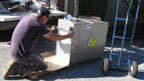
An otherwise desirable house for sale may have too much concrete covering the ground in the form of patios, driveways or walkways. Or someone may want to turn that extra expanse of concrete into lawn or garden. Removing reinforced concrete -- embedded with steel mesh, rebar or other metal rods -- generally requires the use of heavy machinery, but unreinforced concrete can be relatively easy to break into manageable pieces.
Typical costs:
Unreinforced concrete can be removed with a prybar and sledgehammer; with power tools such as an electric jackhammer and/or a concrete saw; or heavy equipment such as a backhoe or mini-excavator (sometimes called a skid-steer or bobcat) with a breaker attachment. Do-it-yourself costs can be zero or $50-$500 or more depending on how much time the project takes; whether equipment needs to to bought or rented; local recycling/dump fees; the size of the area being removed and whether it's attached to something that must be preserved; and the thickness of the concrete. Prices vary, but renting an electric jackhammer can be about $50-$100 a day; a concrete saw about $30-$50 (with possibly $50-$150 more for wear on a diamond-tipped blade); and a small skid-steer with a breaker attachment can be $150-$350 a day. Three friends[1] broke a 9x22-foot concrete patio (about 6 inches thick) into manageable chunks in about two hours using a rented jackhammer.
The biggest part of a do-it-yourself removal job will be hauling away and disposing of the debris. In some parts of the country recycling fees for concrete are relatively low, but in other areas dump/disposal costs can be $300-$800 or more for the concrete from a typical two-car driveway.
For small jobs removing unreinforced concrete (no rebar) you can often hire a local day laborer or handyman to manually break up and haul away the concrete for $100-$400 for a small area such as a patio or $500-$900 for a 500-600 square foot (unreinforced) driveway.
Contractors' prices for 2-4 hours with heavy equipment removing a small area of concrete (such as a 8x10-foot patio 4-8 inches thick) start around $250-$550 and go up. Removing an average driveway is $1,000-$2,500 and up, particularly if it's reinforced concrete. Prices vary considerably by region.
Concrete foundation removal can run $600-$4,000 or more for a simple slab, and $1,500-$5,000 or more for a typical home basement.
At least two business days before doing any digging, call 811 (the free national Call Before You Dig service) to have utility companies mark any underground lines on your property. And check with your local planning department -- many require a demolition permit and/or inspections, depending on the size and nature of the concrete removal project.
Depave.org provides a detailed overview[2] . RentalHQ.com gives tips for using a rented skid-steer or concrete saw, and a video[3] shows the use of a mini-excavator to remove a concrete sidewalk.
A heavy equipment operator can usually remove a typical concrete driveway in about 5-8 hours, depending on the thickness, whether it's reinforced and ease of access. If included in the contract, the contractor may add a layer of topsoil and grade (level) the site.
Additional costs:
If required, a demolition permit often costs only $15-$50, but can be much more in some areas.
Discounts:
Some concrete supply companies accept broken-up concrete for free or for a small fee, then grind it up and reuse it, and Some contractors use broken-up concrete as fill for other projects.
Shopping for concrete removal:
Removal work can be done by day laborers or a local handyman. For larger or more complex projects requiring heavy machinery, paving companies often also do removal. Referrals are available through the National Pavement Contractors Association and the National Demolition Association[4] .
Get several estimates. Ask about specific experience with this type of project. The estimator/contractor should walk the site with you, discussing any potential problems with access, underground utility lines or final grading/drainage. Be sure you understand exactly what's included in each estimate, such as how the area will be left when the work is done. Ask for and check references.
Make sure the company is properly insured, bonded and licensed (demolition licensing requirements vary by state).
7 Lesser-Known Discounts for the 50+ Crowd As they age, members of the Baby Boomer generation don't like to admit that they're senior citizens, but they love getting discounts. It's kind of a quandary, because some of the best deals available are reduced prices for older folks. || Posted October 21 2013
7 Ways to Stretch Your Reduced Food Budget End of the year budgets are tight for everyone, especially in this economy.It's especially hard for the millions of Americans who depend on government programs like food stamps to help make ends meet. || Posted November 11 2013
Its impossible for anyone to remove concrete on a pool deck AND add pavers back for $3.00 a foot. Maybe the demo of the conrete plus removal was 3 dollars a foot, but pavers themselves, even the cheap ones cost $3.00 a foot just for the materials and you still have to put in aggregate bass,plus sand finish and sweta equity. Pavers installed with the minus 6"-7" for walkpath paver install is about $8.50 a foot competitively. Add your 3.00 a foot top end demo and haulf of pric3 of $3.00 a foot, and you can say that estimated at $12.00 a foot you should be well covered to put a budget togethr to hire a professional to bust slab, remove concrete, and install mid range pavers. High end pavers can run a few dollars more if upper tier, similar. . # bucks a foot is covering you fpr a pro doing the tear out. Add 300 - 400 for dumpster budget or 200 plus time to do dump runs.
Contractor used jackhammer to break up three 2x2' cracked slabs, remove debris; then re-pour the slabs. They also added a step, and filled a small strip that was previously mulched. Included rebar under the slabs. Quality job. I think it was fair price.
CostHelper is based in Silicon Valley and provides consumers with unbiased price information about thousands of goods and services. Our writers are experienced journalists who adhere to our strict editorial ethics policy.
CostHelper Community
UTI urgent care visit Paid: 147.00 Visit was $135. Antibiotics was $12. Waiting for four hours in the waiting room and the visit was quick... [more]
Spanish Medical Interpreter Paid: 150.00 I worked with SynShyne Services out of Monroe, NC. They were so worth the price! Professional, friendly, accurate, great attitude and always on time. I recieved an itemized report after every contact and a user friendly invoice weekly... [more]
Skin prick allergy test Paid: 573.00 Took my 9 yr. old in after an allergic reaction to eggs. Several panels for nuts, fish & top 8 allergens. Sure enough, egg came up. Got a script for epinephrine and left... [more]






 Post
Post