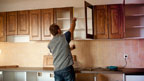
Whether building a new house or constructing an addition to an existing home, once the foundation and utilities are in place the next step is framing -- erecting the basic skeleton of the structure, creating its essential support and shape. The frame of a house carries the weight load of the roof down to the foundation so the entire structure is supported, and provides a weather-tight barrier against the elements.
Typical costs:
Framing projects are typically bid by the square foot and the complexity of the project (steep roofs, vaulted ceilings or "cut up" roofs that are not standard rectangles all cost more). Framing carpenters are usually subcontractors who work for a general contractor on a specific building project; most framing contractors provide labor only, with the general contractor (or the owner-builder) buying the materials separately. In some areas a framing project includes only basic framing while elsewhere it's standard for framers to install roof shingles, doors, windows and house wrap. Some framers charge for each square foot under the roof; others charge only for living spaces; and still others others have different rates for living spaces compared to a garage or covered porch.
Framing labor can cost $2-$12 or a more a square foot, or $3,500-$36,000 for a 1,600- to 3,000-square-foot home, depending on location and what's included. An average house framing labor rate nationwide is about $6-$8 a square foot, or $10,000-$25,000 for 1,600-3,000 square feet. For example, at DoItYourself.com[1] a homeowner reports paying $12,000 for framing labor for a 1,600-square-foot home plus basement and two-car garage, or about $7.50 a square foot. At OwnerBuilderBook.com[2] a Tennessee homeowner reports a bid of $5.50 a square foot for 2,900 square feet of living space and $2.25 a square foot for 850 square feet of garage and porch, or about $17,900, including installing roof shingles, doors and windows; and a Seattle area resident received bids of $25,000-$64,000 for framing labor for 4,100 square feet plus a 950-square-foot garage and 325-square-foot porch ($6-$11.90 a square foot).
Some new homes might use steel framing, but most residential construction is done with wood framing. Framing materials typically cost more than labor. It can cost $3-$12 or more a square foot based on the current price of lumber (or steel) and the size and design of the structure. For example, at GardenWeb.com[3] a Pacific Northwest resident reports on two projects: a 5,600-square-foot, two-story home with a three-car garage and 9'-10' tall ceilings at $42,000 for lumber (about $7.50 a square foot) and $27,500 for labor ($4.91 a square foot), or $69,500 total framing costs ($12.41 a square foot); and a 3,500-square-foot single-story home with vaulted ceilings and bonus room over a three-car garage at $30,000 for lumber (about $8.53 a square foot) and $18,000 for labor (about $5.15 a square foot) or $48,000 total (about $13.72 a square foot).
Wall sections are typically constructed on the ground or floor surface, then raised into place. Precision is important; in a poorly framed finished house the drywall may not be flat, the floors could squeak and the doors might not close properly. AlsNetBiz.com illustrates and defines basic framing terms[4] . A framing company posts a video of the framing process[5] . This Old House lists framing tips[6] and AskTheBuilder.com explains roof framing basics[7] .
An average 1,800-square-foot house typically takes two to three weeks to frame, according to InfoForBuilding.com[8] .
Shopping for house framing:
The American Forest and Paper Association explains Conventional Wood Frame Construction[9] .
An owner-builder buying framing materials should take a set of plans to at least three lumber yards for a list of the individual quantities and costs. This Old House discusses modern framing materials[10] and how to read the grade stamp[11] found on framing lumber.
A general contractor will be familiar with local framing subcontractors; owner-builders can ask other subcontractors on the project for recommendations. Verify that the framing contractor is properly bonded, insured and licensed; and check references.
Most framing contractors require a deposit (10%-50% of the total cost). Final payment should be contingent on the framing being done according to the plans, plus holding back 10% until the framing passes any required inspections. The written labor contract should list all costs including the rate for work not covered by the original bid (referred to as a change order); a start and completion date; any penalties to the framing contractor if work isn't completed on time; and any materials or equipment rentals included in the contract.
7 Lesser-Known Discounts for the 50+ Crowd As they age, members of the Baby Boomer generation don't like to admit that they're senior citizens, but they love getting discounts. It's kind of a quandary, because some of the best deals available are reduced prices for older folks. || Posted October 21 2013
7 Ways to Stretch Your Reduced Food Budget End of the year budgets are tight for everyone, especially in this economy.It's especially hard for the millions of Americans who depend on government programs like food stamps to help make ends meet. || Posted November 11 2013
One guy bid $22000. I framed it with one helper in 6 days. I paid the helper total of $960 and bought his lunch every day he was happy and I got some exercise.
The price was for labor only and included the framing, sheeting, setting stairs, installing windows and doors, framing of a small deck, plus sheeting some storage space. The labor prices I was quoted were from $20 to $30 a square foot. Everyone said they have to charge more per square foot when the house is smaller or more detailed.
Framing a 1253sq/ft. chalet type cabin. Cathedral ceiling and a lot of small spaces. Framing costs included all windows and doors as well as a wrap around deck on 3 sides, two are covered. Framing to a semi dried in, shingles and siding extra. I am acting as my own GC and architect (I am a degreed engineer) with a licensed GC supervising.
Posted by: Happy new home owners in North Branch, MN.
Posted: May 19th, 2018 07:05AM
Square Feet: 3800
Material:
Framing contractor charged $6.25 sq ft.....House is a rambler with finished walkout basement, four car garage and hip roof. Truely a great price....average price in this area is $6-$8 per square for framing.
Two very large 18:12 roof pitches in the front with everything else roughly 8:12 pitch. This did NOT include shingles, but did include windows and exterior doors. It took almost 5 months to frame.
I was the general and my wife with architect designed the home. 3 bed 2 1/2 bath home with attached garage. Vaulted living room, hardwood and tile except for bedrooms. Contracted framing, roofing, drywall, electrical and insulation. Our family did the balance of the completion. We owned the lot with utilities in. The total cost was $135,000. Appraisal when converting from construction loan to conventional loan in 2012 was $279,000. We paid $18,500.00 for lot in 1991.
I am acting as my own GC on my home. I did a bid with 3 framers. The highest was 7.00 a sq ft. The other two were around 6.50. I went with the more expensive because after checking on there past work the more expensive was alot better in speed and quality.
CostHelper is based in Silicon Valley and provides consumers with unbiased price information about thousands of goods and services. Our writers are experienced journalists who adhere to our strict editorial ethics policy.
CostHelper Community
UTI urgent care visit Paid: 147.00 Visit was $135. Antibiotics was $12. Waiting for four hours in the waiting room and the visit was quick... [more]
Spanish Medical Interpreter Paid: 150.00 I worked with SynShyne Services out of Monroe, NC. They were so worth the price! Professional, friendly, accurate, great attitude and always on time. I recieved an itemized report after every contact and a user friendly invoice weekly... [more]
Skin prick allergy test Paid: 573.00 Took my 9 yr. old in after an allergic reaction to eggs. Several panels for nuts, fish & top 8 allergens. Sure enough, egg came up. Got a script for epinephrine and left... [more]






 Post
Post